Overview
A rapidly growing SaaS App Builder platform enabled businesses to create, customize, and deploy applications without extensive development resources. As adoption increased and enterprise customers began onboarding to the platform, security became a critical priority.
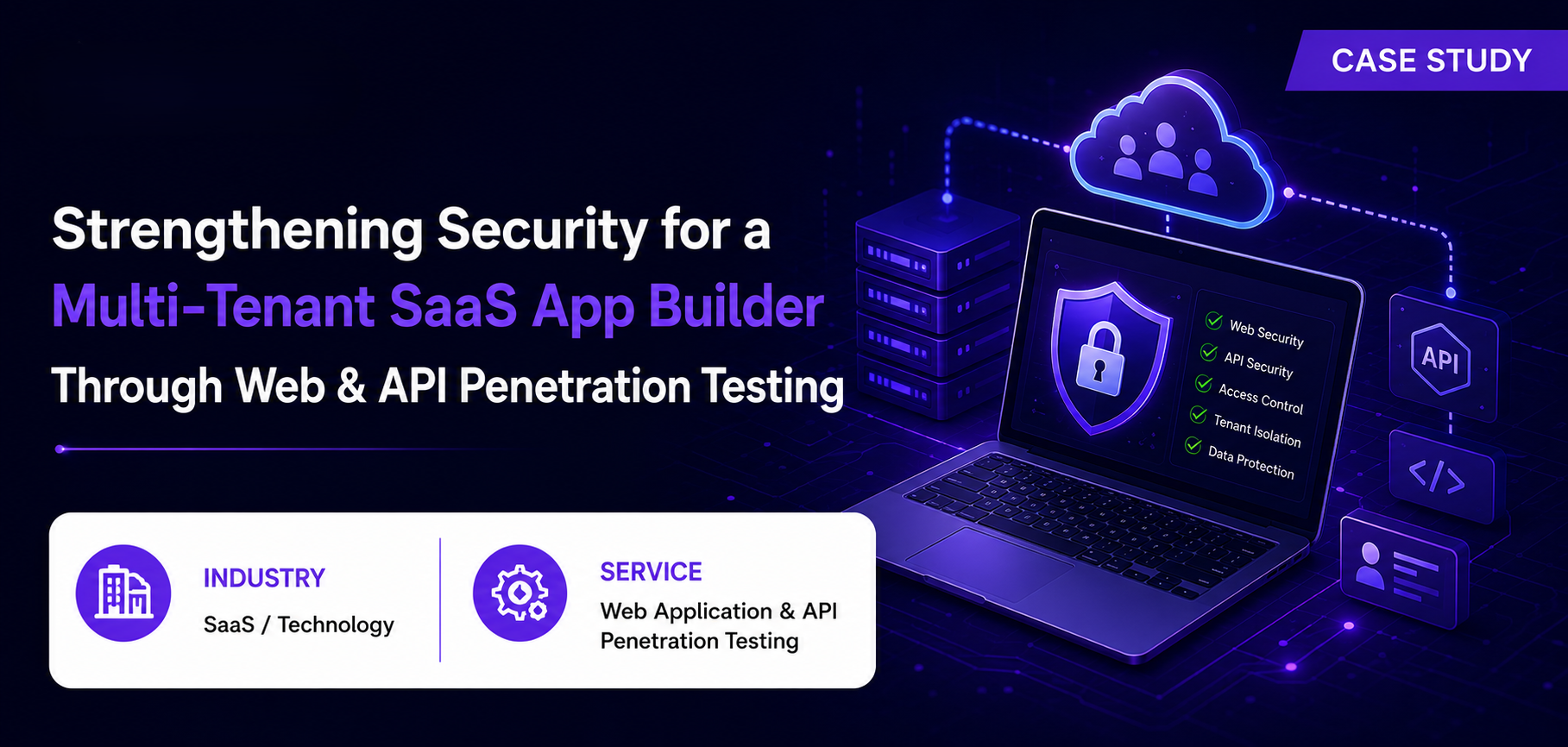
The platform relied on a multi-tenant architecture, allowing multiple organizations to operate within a shared environment. While this model offered scalability and efficiency, it also introduced security challenges related to access control, tenant isolation, and API security.
To proactively identify potential risks, a comprehensive Web Application and API Penetration Test was conducted before the platform’s next growth phase.
The Challenge
The platform handled sensitive business data, user-generated applications, and customer-specific configurations. Any weakness in access controls or tenant separation could potentially expose customer information or impact platform integrity.
The assessment was initiated to answer several critical questions:
- Could users access data belonging to other organizations?
- Were APIs enforcing proper authentication and authorization?
- Could business workflows be manipulated to bypass intended restrictions?
- Were there hidden vulnerabilities that automated scanning tools might miss?
The goal was to identify and remediate security weaknesses before they could be exploited in a real-world attack.
Scope of Assessment
The security assessment covered the following areas:
Web Application Testing
- Authentication mechanisms
- Authorization controls
- Session management
- Input validation
- User privilege enforcement
API Security Testing
- REST API endpoints
- Access control validation
- Token handling
- Data exposure analysis
- Rate-limiting effectiveness
Multi-Tenant Security Validation
- Tenant isolation controls
- Cross-tenant access testing
- Role-based access verification
Business Logic Testing
- Workflow manipulation scenarios
- Privilege escalation attempts
- Unauthorized action validation
Assessment Methodology
The engagement combined manual testing techniques with targeted security analysis to simulate how an attacker might interact with the platform.
Application Mapping
The platform’s functionality, user roles, workflows, and API architecture were analyzed to understand the overall attack surface and identify areas requiring deeper inspection.
Authentication & Authorization Review
Testing focused on validating whether users could access resources, actions, or data beyond their assigned permissions.
API Security Evaluation
The APIs supporting the platform were assessed for common and advanced security risks, including authorization weaknesses, excessive data exposure, and insecure object references.
Tenant Isolation Testing
Special attention was given to verifying whether customers operating within the shared environment remained properly isolated from one another.
Business Logic Analysis
Core application workflows were examined to determine whether users could manipulate processes in unintended ways to gain unauthorized advantages or access.
Key Findings
The assessment identified several security weaknesses that required remediation.
Access Control Weaknesses
Certain application functions relied heavily on client-side restrictions without sufficient server-side validation. This created opportunities for unauthorized actions under specific conditions.
Insecure Object References
Several application components exposed predictable identifiers that increased the risk of unauthorized resource access if additional controls were not enforced.
API Authorization Gaps
A number of API endpoints required stronger authorization validation to ensure users could only access resources associated with their own accounts and permissions.
Excessive Information Exposure
Some responses contained unnecessary metadata that could assist attackers in understanding the application’s internal structure.
Business Logic Risks
Specific workflows could potentially be manipulated to perform actions outside the intended business process, increasing the likelihood of unauthorized behavior.
Tenant Isolation Improvements
While no direct cross-tenant compromise was observed, additional security controls were recommended to further strengthen customer environment separation.
Remediation Actions
Following the assessment, a structured remediation plan was implemented.
Key improvements included:
- Strengthening server-side authorization checks
- Enhancing role-based access controls
- Securing API authorization mechanisms
- Reducing unnecessary data exposure
- Improving session security controls
- Hardening tenant isolation boundaries
- Integrating secure coding practices into the development lifecycle
Each issue was prioritized based on risk level, exploitability, and potential business impact.
Results
Following remediation and validation testing, the platform demonstrated a significantly improved security posture.
Outcomes
- Critical access control weaknesses addressed
- Improved protection of customer and organizational data
- Stronger API security controls implemented
- Enhanced tenant isolation mechanisms
- Reduced risk of unauthorized access
- Increased readiness for enterprise customer onboarding
Business Impact
For SaaS platforms, security directly influences customer trust, compliance readiness, and long-term growth.
By proactively identifying and addressing vulnerabilities, the organization was able to strengthen its security foundation before expanding its customer base. The assessment also provided valuable insight into areas requiring continuous monitoring and improvement as the platform evolved.
Conclusion
Modern SaaS platforms rely heavily on web applications and APIs, making them attractive targets for attackers seeking unauthorized access to data and functionality.
This assessment highlighted the importance of validating access controls, API security, business logic, and tenant isolation through comprehensive penetration testing. By addressing identified risks, the platform improved its resilience against real-world threats while creating a more secure environment for its customers.
Key Takeaway
Security issues within SaaS platforms are not always the result of obvious vulnerabilities. Access control gaps, API authorization weaknesses, and business logic flaws can remain hidden until examined through a focused security assessment. Regular Web Application and API Penetration Testing helps identify these risks early and supports secure platform growth.